
Singapore-Pacific Resilience and Knowledge Sharing (SPARKS)
SPARKS supported Pacific Island Forum Member States in building climate-resilient futures.
Last updated 14 September 2026
Programme Overview
The Singapore-Pacific Resilience and Knowledge Sharing (SPARKS) Programme was launched by Singapore’s Ministry of Foreign Affairs at the 52nd Pacific Islands Forum Leaders Meeting in November 2023. From 2024 to 2026, SPARKS supported Pacific Islands Forum (PIF) member states in strengthening capabilities in climate resilience, cybersecurity and international law.
The Centre for Liveable Cities (CLC) curated the climate resilience stream through a three-year modular programme, Towards Climate Resilience and Urban Sustainability for the Pacific.
The programme brought together city leaders and senior officials from 12 PIF member states over three years. Participants exchanged experiences and insights, explored Singapore’s urban development approaches, and built a network of practitioners working on climate and urban challenges across the Pacific.

Programme Journey (2024–2026)
Module 1 (2024): Foundations for Climate Resilience
Module 1 introduced participants to Singapore’s integrated approaches to climate resilience, urban governance and sustainable development, including the application of systems thinking. Participants explored frameworks and initiatives such as the Liveability Framework and Singapore Green Plan, and learnt how government, academia and industry work together to support a sustainable and resilient city.
Module 2 (2025): Deep Dive into Climate Resilience Challenges
Building on Module 1, participants explored priority areas identified by PIF member states, including coastal protection, inland flood management and water resource management.
Through CLC’s Action Planning component, participants applied insights from the programme to challenges in their own cities and communities. Working with peers and resource persons, they developed practical responses tailored to their local contexts.
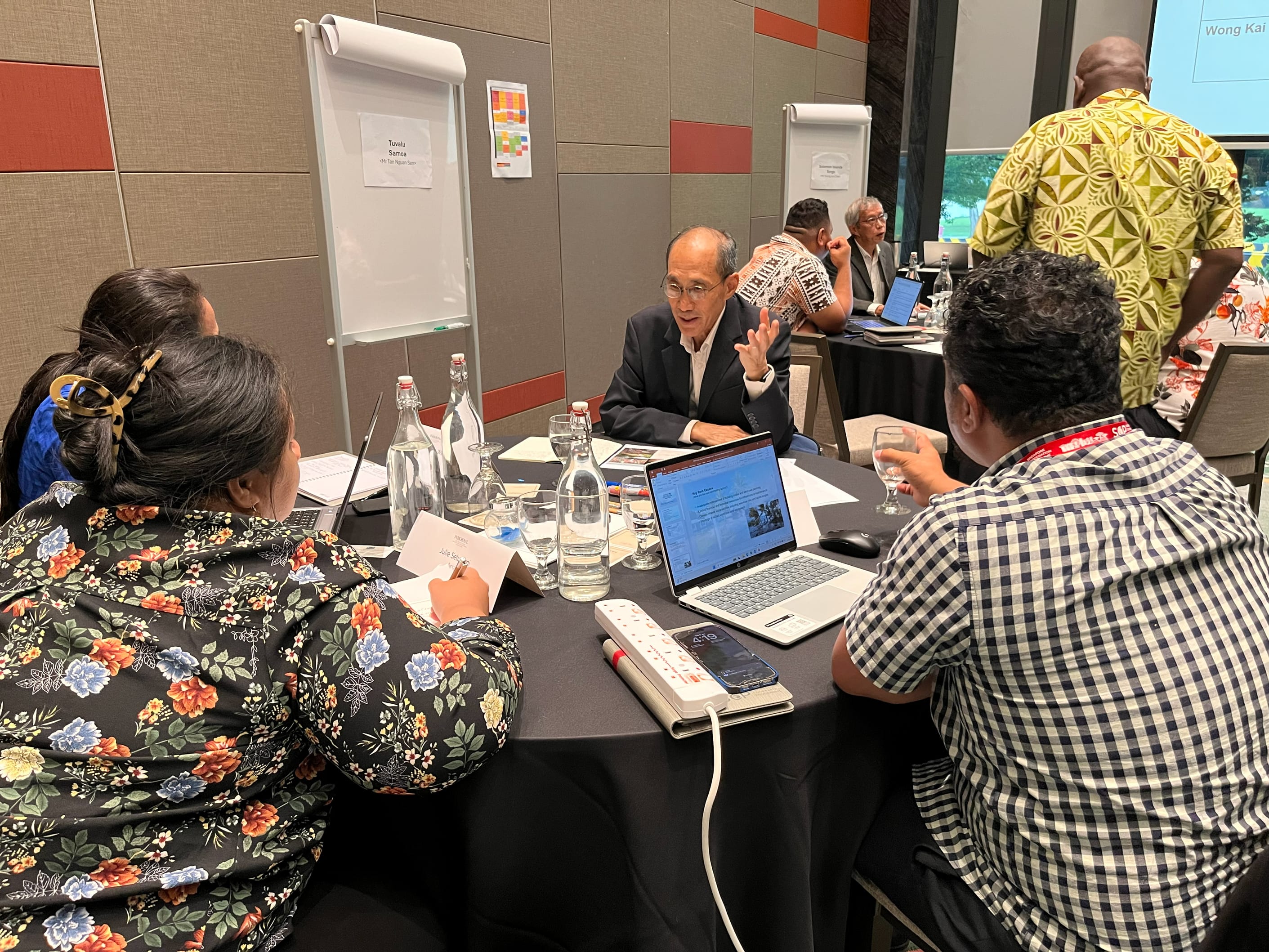
Participants discussing urban resilience solutions with Singapore resource persons during Action Planning component.
Module 3 (2026): From Planning to Implementation
The final module focused on translating plans into implementation. Participants refined their Action Plans through peer exchange, expert feedback and discussions on governance, financing, stakeholder engagement and implementation.
Workshops on sustainable infrastructure financing and behavioural insights provided additional tools in strengthening the feasibility and delivery of their proposed interventions. The programme culminated with presentations of Action Plans addressing flooding, coastal resilience, water security, waste management and sustainable urban development.
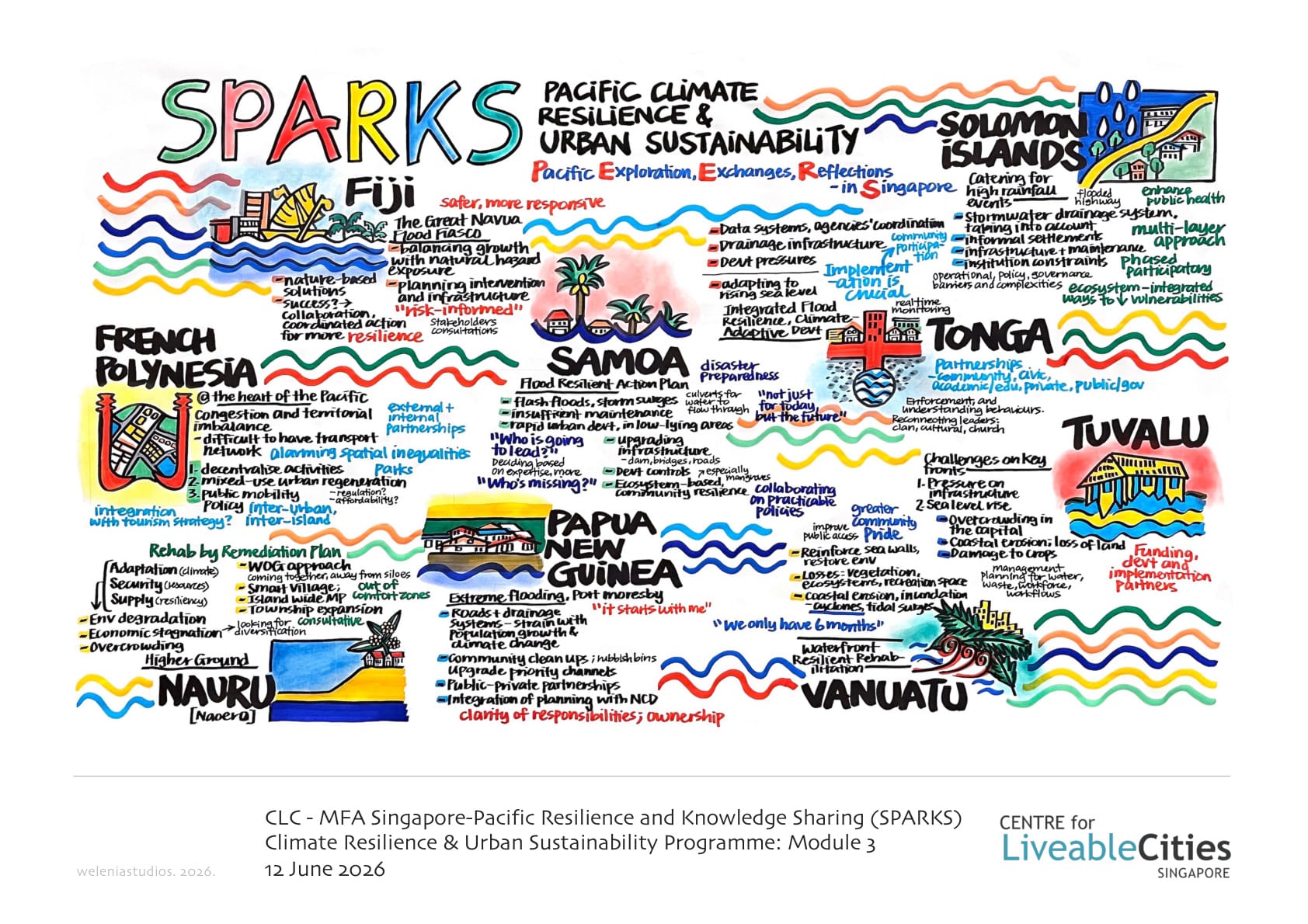
Programme Outcomes
12 PIF member states participated over the three-year programme, strengthening capabilities in climate resilience and urban sustainability.
Nine Action Plans were developed and presented, addressing challenges including flooding, coastal resilience, water security, waste management and sustainable urban development.
Eight virtual consultations supported participants in developing their Action Plans from initial concepts towards practical implementation.
Built a regional network of Pacific Islands practitioners, Singapore agencies, development partners and subject-matter experts, creating opportunities for continued peer exchange and collaboration.
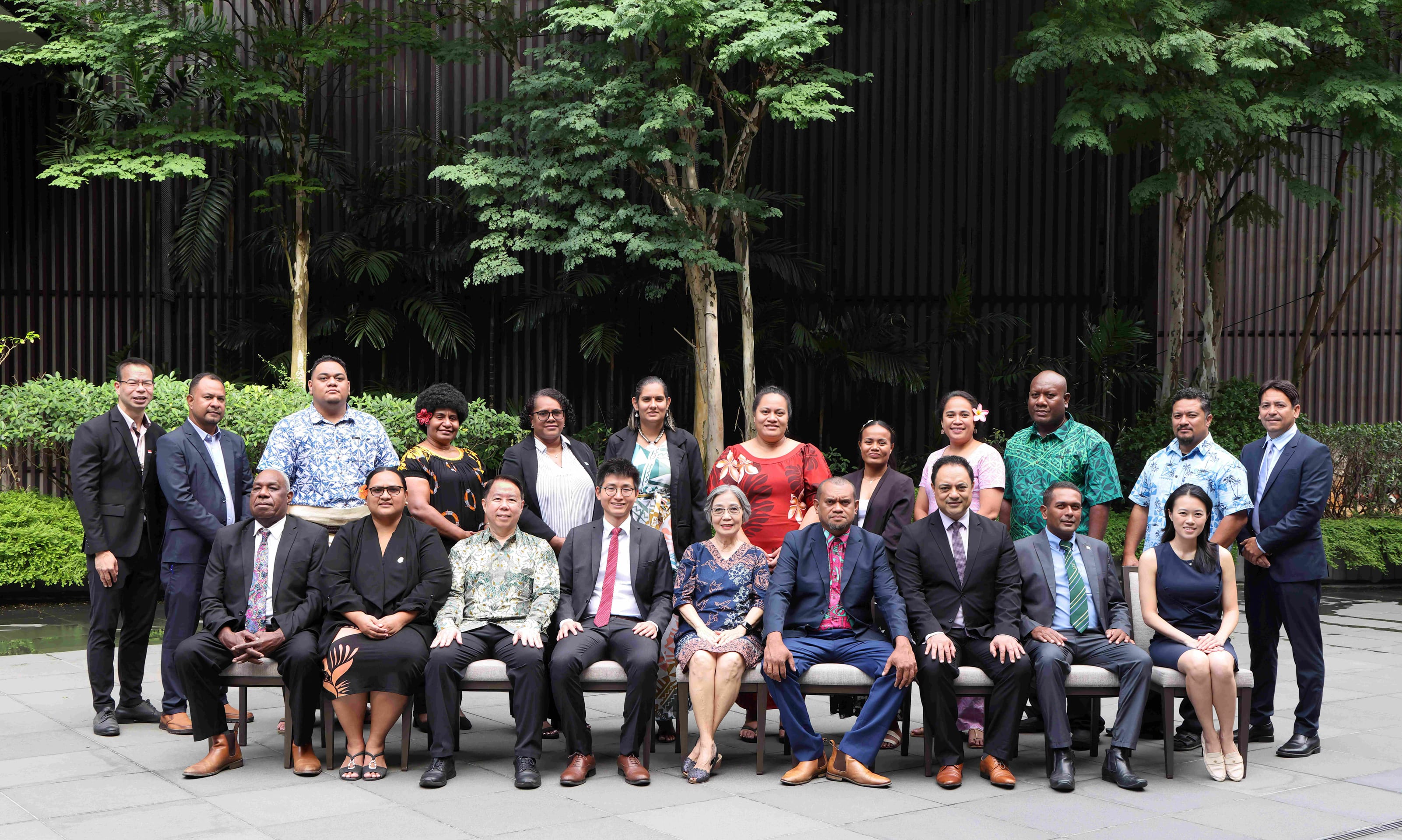
Participants of SPARKS Module 3, in Singapore, June 2026
Participants’ Testimonials
Each session met their objectives comprehensively and were delivered by knowledgeable and engaging resource persons. The tours, including the Singapore City Gallery and Singapore River Cruise, provided valuable insights into urban planning and development. The content was not only informative but also directly applicable to my current projects, particularly in sustainable planning and critical infrastructure resilience. I strongly recommend retaining all these sessions for future programs due to their practical relevance and the quality of delivery.— Mr Taaniela Kula, Chief Executive Officer, National Spatial Planning Authority, Ministry of Lands, Survey, Planning and Natural Resources, Kingdom of Tonga
The presentations and information sharing amongst participants really fits my work back home and it can also help with our developments and capacity building back in Samoa.— Ms Julie David Simi Selu, Senior Strategic Planning Officer, Planning and Urban Management Agency (PUMA), Ministry of Works Transport and Infrastructure (MWTI), Samoa
The programme was exceptionally well-organized and delivered, providing valuable insights and practical knowledge across various key areas of urban planning, sustainability, and climate resilience. The opportunity to learn from experts and network with peers was invaluable, and I am grateful for the enriching experience.— Mr Avio Niki Roberts, Deputy Town Clerk, Luganville Municipal Council, Vanuatu
The presentations on development financing and project implementation, particularly the World Bank officer's sharing of experiences from projects in Vanuatu, were highly relevant. The visit to the Waste-to-Energy Plant was also very informative and provided valuable practical learning.— Mr Jordy Chan, Minister, Ministry of Public Works and Infrastructure, French Polynesia
I will return now with a changed perspective on how I will address urban development and climate challenges with better insight. Behavioural Insights will be a game changer, as building more sustainable and liveable cities requires ownership, collaboration and understanding the root causes of problems.— Ms Jealchris Inji, Executive Officer, National Housing Corporation, Papua New Guinea
Behavioural Insights is quite a new concept for me but definitely needed. The feedback from the resource persons was invaluable.— Ms Enolagay Edward, Presidential Advisor, Government of Nauru
Lasting Impact
SPARKS concluded in June 2026 with an overall participant rating of 4.9 out of 5. Over its three-year run, the programme strengthened climate resilience capabilities, shared Singapore’s urban development experience and fostered collaboration among PIF member states.
The Action Plans, professional networks and partnerships developed through SPARKS provide a foundation for continued knowledge exchange and cooperation on climate resilience across the Pacific.