
LKYWCP Network Webinar #1 - From Industrial Decline to Urban Renaissance: What Cities Can Learn From Bilbao’s Transformation
This is the page summary
Last updated 30 March 2026
Webinar details
LKYWCP Network Webinar #1 - From Industrial Decline to Urban Renaissance: What Cities Can Learn From Bilbao’s Transformation
22 January 2026
[GMT+8] Singapore, 7.00pm – 8.30pm
[GMT+1] Bilbao, 12.00pm – 1.30pm
Platform: Zoom
This webinar has ended.
Synopsis
The lecture by Asier Abaunza Robles, Councillor Delegate of the Bilbao City Council, examined Bilbao’s transformation from an industrial port city facing economic and environmental decline in the 1980s to a globally recognised model of urban regeneration. Over 25 years, the city implemented 25 major urban interventions that collectively revitalised its economy, mobility systems, environment, and social fabric. The lecture traced the origins of this transformation and highlighted key projects such as Zorrotzaurre, alongside ongoing strategic initiatives shaping the city’s future. Bilbao’s experience underscored how sustained political consensus, coordinated governance, and integrated planning across infrastructure, environmental restoration, and social development enabled deep and lasting urban change.
Webinar Report
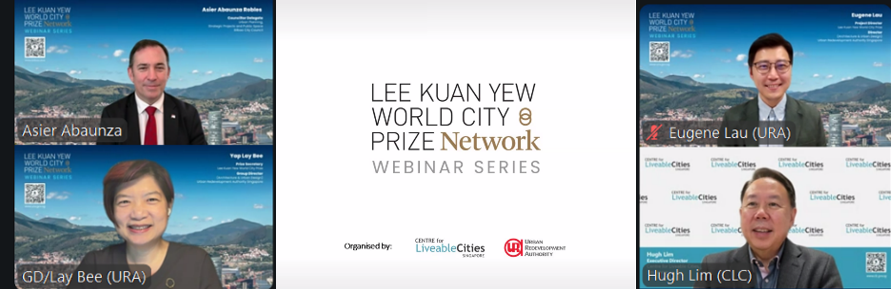
Inaugural edition of the LKYWCP Network Webinar Series. Image Credit: Courtesy of Urban Redevelopment Authority (URA) Singapore
A City in Crisis
Bilbao’s transformation began in crisis. By the 1980s and early 1990s, the city was confronting the collapse of its heavy industrial base, severe unemployment, environmental degradation, catastrophic flooding in 1983, and social instability. The river had become heavily polluted, port infrastructure dominated the waterfront, rail tracks and highways divided neighbourhoods, and large tracts of flat land were occupied by obsolete industrial uses.
The city recognised that its future could no longer depend on heavy manufacturing. Instead, it pivoted towards advanced services, knowledge-intensive industries, and culture-led regeneration. More importantly, Bilbao’s leaders understood that economic transformation would only succeed if the physical city was redesigned to support it.
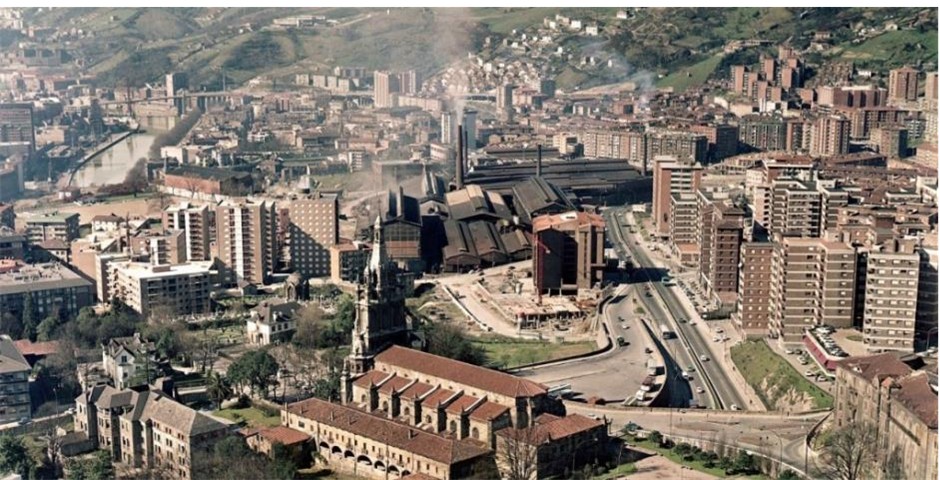
Heavy Industries in Bilbao in the early 1990s Image Credit: Courtesy of the City Council of Bilbao
Playing the Long Game
A key enabler was the adoption of long-term General Urban Plans in 1995 and again in 2022. These plans looked 20 to 30 years ahead and were supported by broad political consensus. Importantly, the strategy was shared across parties and institutions, reducing the risk of policy reversals. Asier Abaunza Robles emphasised that continuity across political cycles is indispensable for deep urban change. Without agreement on long-term direction, cities risk fragmentation and stalled progress.
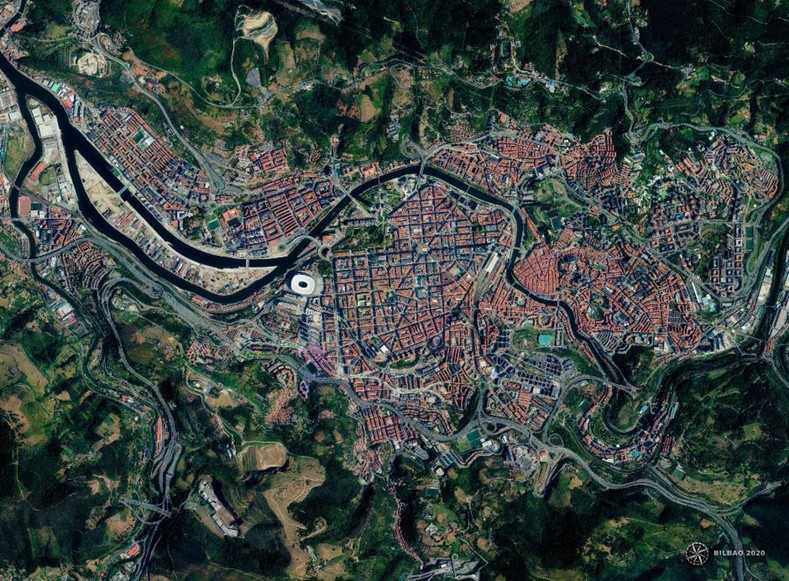
The Urban Plan of 1995. Image Credit: Courtesy of the City Council of Bilbao
Creating a Robust Governance Structure
One of Bilbao’s most instructive innovations was the creation of Bilbao Ría 2000, a publicly owned redevelopment corporation established to coordinate land, financing, and implementation across multiple public institutions. Many of the key industrial and port lands were owned by the Spanish central government, while planning authority and fiscal autonomy lay with Basque institutions. Institutional fragmentation could have paralysed redevelopment.
Bilbao Ría 2000 provided a platform for public-public partnership, which Asier Abaunza Robles noted can often be more complex than public-private collaboration. Through land transfers, rezoning, and strategic development, the corporation generated revenue from land sales to fund infrastructure projects. Over 30 years, it invested approximately €1 billion and returned to financial surplus by 2019. This revolving financing model allowed value captured from redevelopment to be reinvested into subsequent projects.
The key lesson is that structural governance mechanisms are often necessary to overcome jurisdictional silos in metropolitan transformation.
Prioritising Environmental Regeneration
While global attention often focuses on the Guggenheim Museum, Asier Abaunza Robles underscored that the environmental regeneration of the river was arguably more transformative. Approximately US$1 billion was invested over three decades to overhaul sewerage systems, eliminate industrial discharge, and restore water quality.
The river, once biologically dead, now supports aquatic life and recreational use.
The implication is clear: environmental repair is not an accessory to urban transformation — it is foundational to economic repositioning, public health, and long-term liveability.
Removing Divisive Infrastructure
The relocation of the port from the inner river to the outer bay liberated prime waterfront land for redevelopment. This enabled the transformation of the Abandoibarra district, which now houses cultural institutions including the Guggenheim Museum Bilbao and the Palacio Euskalduna, alongside housing, offices, and public parks. The Guggenheim, initially controversial, repaid its public investment within four years through increased tax revenues and catalysed Bilbao’s global rebranding
Yet the transformation extended far beyond landmark architecture. Railway lines that once cut through neighbourhoods were systematically buried, highways were removed or downgraded, and surface land was reclaimed for parks, housing, and pedestrian spaces. In some cases, housing developments (with up to 50 per cent social or affordable units) were used to cross-subsidise the cost of burying infrastructure. Elevated Franco-era highways were demolished and replaced with tunnels and parks, restoring human-scale urban continuity.
These interventions demonstrate a powerful principle: removing divisive infrastructure can be as transformative as building new infrastructure. Physical reconnection fosters social cohesion and spatial equity.
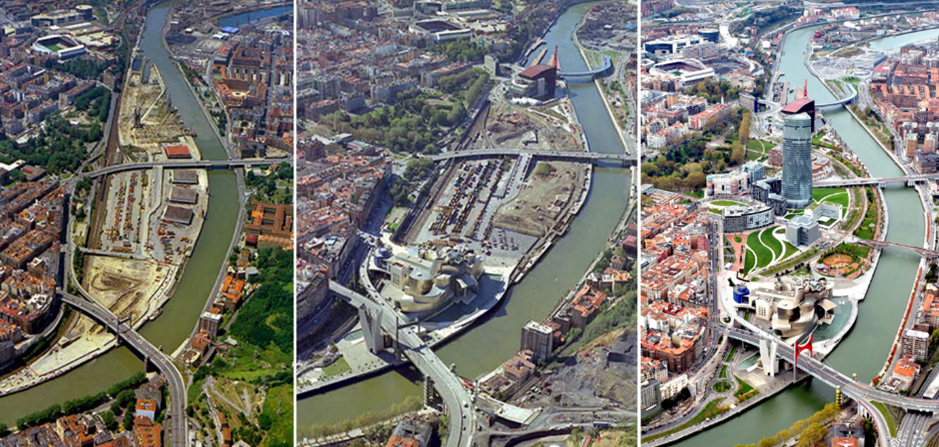
Master Plan of Abandoibarra. Image Credit: Courtesy of the City Council of Bilbao
Integrating Social Housing with Key Developments
A defining feature of Bilbao’s projects is the consistent integration of social housing within central redevelopment areas. Large projects such as Zorrotzaurre Island (5,500 homes, 50 per cent affordable housing) and Punta Zorrotza (2,000 homes, 43 per cent affordable housing) embed equity directly into spatial transformation.
Citizen engagement also played a critical role. During the development of the 2022 General Urban Plan, 4,000 residents participated in consultations. To improve understanding, the city used virtual reality tools and simplified communication materials to make complex urban plans accessible to non-technical audiences. In some cases, projects were revised — or even cancelled — based on neighbourhood input.
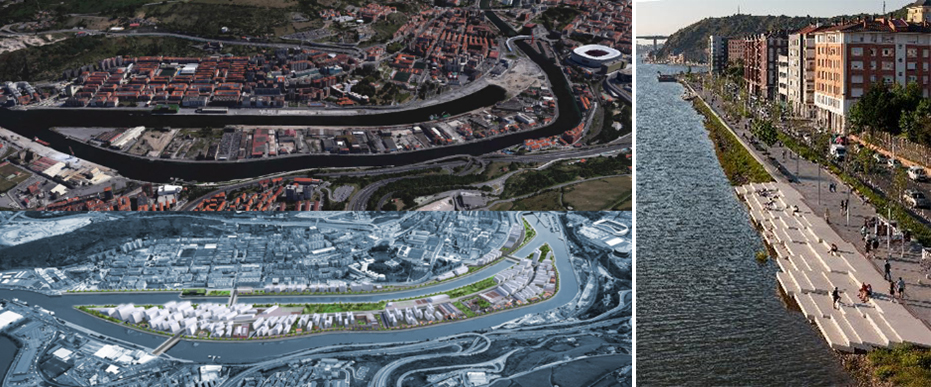
Zorrotzaurre Master Plan (left) and the riverbank of Zorrotzaurre (right) Image Credit: Courtesy of the City Council of Bilbao
Learning from Bilbao's Transformation
Asier Abaunza Robles advises city leaders to dream big, but be grounded, ensuring plans are viable and financially realistic. Bilbao’s transformation illustrates that successful urban change requires:
Long-term political consensus
Institutional mechanisms to coordinate public actors
Environmental restoration as groundwork
Strategic use of land value capture
Integration of social equity into redevelopment
Removal of physical barriers to reconnect neighbourhoods
Financial discipline and phased implementation
Ultimately, Bilbao’s experience demonstrates that deep urban transformation is not achieved through isolated flagship projects, but through sustained, coordinated action across governance, infrastructure, environment, economy, and community over decades.
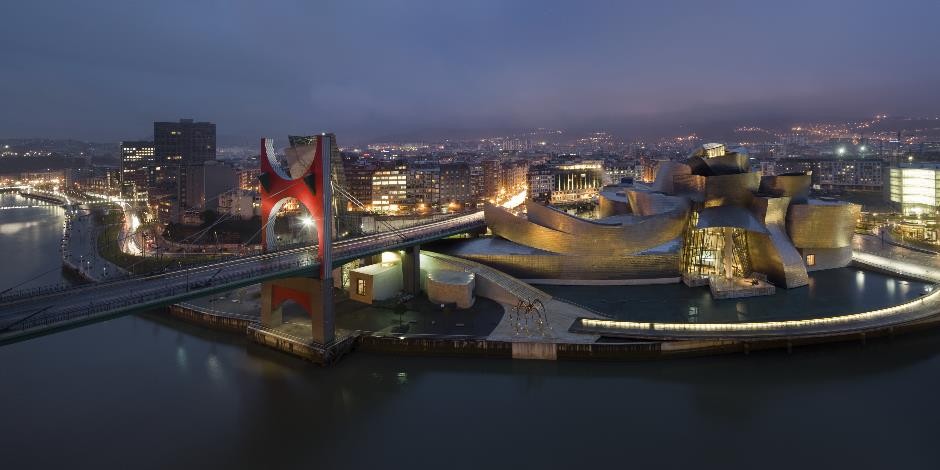
The Abandoibarra waterfront area with the iconic Guggenheim Museum. Image Credit: Courtesy of the City Council of Bilbao
About the City Network for the Lee Kuan Yew World City Prize (LKYWCP Network)
The City Network for the LKYWCP was formed in 2024 as a platform for exchange and dialogue amongst urban leaders working to create liveable and sustainable cities. Its webinar series seeks to share deeper insights and lessons on cities’ transformative efforts. The inaugural webinar on 22 January 2026 co-organised by the Centre for Liveable Cities and the Urban Redevelopment Authority was presented by Bilbao, the first Lee Kuan Yew World City Prize Laureate awarded in 2010.
For more information about the LKYWCP Network, visit www.worldcityprize.sg/network
About the Speakers
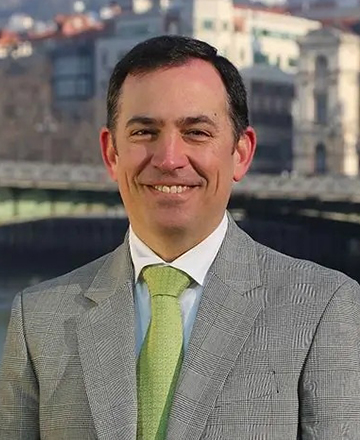
KEYNOTE AND PANEL SPEAKER
Asier Abaunza Robles
Councillor Delegate for Urban Planning,
Strategic Projects and Public Space,
Bilbao City Council
Mr Asier Abaunza Robles holds a degree in Agricultural Engineering from the Public University of Navarre. He is currently Councillor Delegate for Urban Planning, Strategic Projects and Public Space. He has been a councillor in the Bilbao City Council since 2008. During this period, he has been responsible for Mobility, Urban Planning, Civil Works Services and Public Space. He has also been a member of several Boards of Directors, has chaired districts 1 (Deusto) and 3 (Otxarkoaga-Txurdinaga), as well as several municipal companies (Artxanda Funicular, Surbisa amd Bioartigas). Previously, he worked at Lantik, at the Derio Agricultural School, in several private companies and as an advisor to the General Secretariat for Foreign Affairs of the Basque Government.
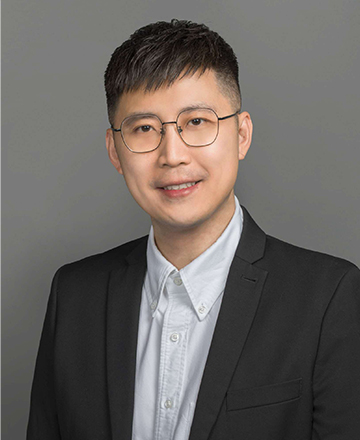
KEYNOTE AND PANEL SPEAKER
Eugene Lau
Director of the Architecture and Urban Design,
Industry and Innovation,
Urban Redevelopment Authority
Mr Eugene Lau is currently the Director of the Architecture and Urban Design, Industry and Innovation department which is part of the Architecture and Urban Design Group in the Urban Redevelopment Authority. Mr Lau has more than a decade of planning and urban design experience, innovating new methodologies of practicing urban design with technology, having formerly served in the Housing and Development Board, as well as leading a team as Deputy Director of the Urban Design Technologies department. Mr Lau graduated with a Bachelor of Arts in Architecture and holds a Master of Architecture from the National University of Singapore.